
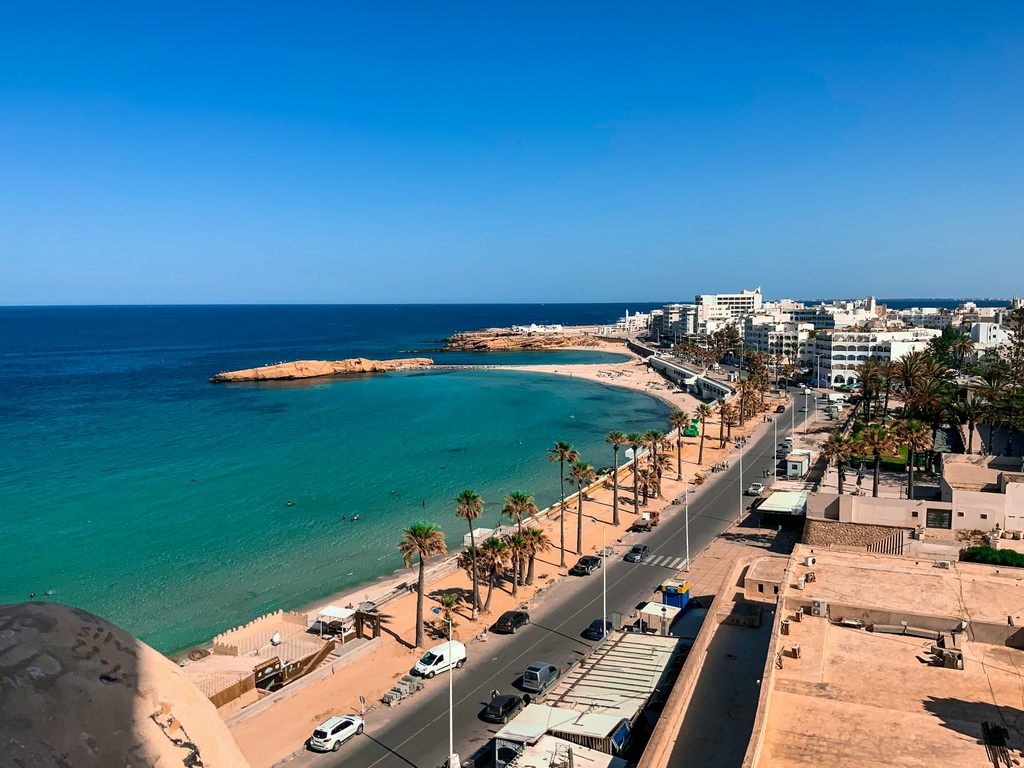
Tunisia in May and June 2026 – is it worth going? Weather in Hammamet and Monastir, Sousse and Djerba, reviews, water and air temperature, is it possible to swim, prices for tours. What to do and see in Tunisia in late spring and early summer – says Eurotraveler.
Tunisia, no matter how hard it tries, cannot yet compete with Turkey as the most popular beach destination in the Old World. Vacationers regularly go to the shores of Asia Minor, believing that a seaside holiday in Antalya and Alanya, Kemer and Bodrum has the best price-quality ratio.
And therefore, is it worth looking for an alternative?
In this regard, the number of those who choose a holiday in Tunisia in defiance of its Asian “colleague” due to fatigue from constant trips to Turkey is relatively small. And some satiety – Antalya and the surrounding area have already been examined more than once – I want something new!
Are you one of those who are “tired” and would like to try to go to Tunisia in May or June in the hope that the weather at this time is not too hot and therefore bearable? A attractions North African country will allow you not to get bored and, on the contrary, to open your eyes wider?
Well, we can state that such hopes are justified. And the weather conditions really soft and are suitable even for small children.
In fact! The climate of Tunisia, both in May and early June, should please the bodies of the most delicate vacationers.
There are other advantages too. For example, jellyfish, which are really unpleasantly numerous along local shores at the peak of the season, at the junction of spring and summer, seem to have not yet woken up from hibernation.
Prices are not too high at this time. And there aren’t so many tourists that it makes sense to avoid them.
However, we will still start with the main thing:
Weather in Tunisia in May
Doesn’t correlate very well with the generally accepted pattern regarding Africa at first. That is, the sun usually reigns in the sky, but there is no particular heat.
On the contrary, at times quite cool. And there is little reason to expect that things will be different in 2026.
The daytime air temperature in Tunisia in early May rather timidly tests values in the range of +20-24 degrees Celsius. This is if we are talking about the northern regions of the country – for example, the island of Tabarka. At night it gets completely cold to just +13-15 °C.
To the south, in Monastir and Sousse, it is a little warmer. But not so much as to declare the season open: usually +20-22 °C, and rarely > + 24 °C.
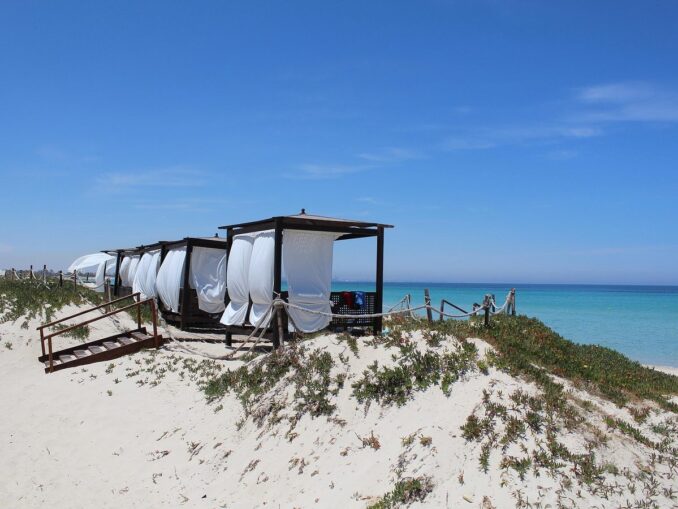
On the island of Djerba, well known to tourists, it’s a little more fun in May – that is, hotter! By noon, the atmosphere warms up to +22-26 °C, and with sunset it does not want to cool below +18-20 °C.
It happens, of course, +28-30 degrees Celsius, but not on an ongoing basis. That is, the feeling of coming high season No.
That is, if you lie motionless on the beach, there is every chance of getting fried and burned. But as soon as you get up and take on a portion of a rather sharp wind from the sea, the desire to walk around in swimsuits or swimming trunks disappears completely.
It is worth considering that despite the relatively modest air temperatures, throughout May the weather in Tunisia is different stability. Some, however, will say that it is not too positive.
Since the number is like 25, actually on the threshold of summer, you subconsciously expect +30 °C – this is Africa, but how could it be otherwise – and in your dreams you wave your removed T-shirt over your head. But reality makes unpleasant adjustments and surprises you with a modest +23-25 °C.
And we, from our (boring) side, will say that it is for the better. Why do you need constant heat, because it’s so tiring?!
There really are enough sunny days, and precipitation is rare. In the northern regions there are 3-5 lightly rainy days throughout May. Somewhere in Monastir in general – no more than 2-3.
How to dress
As most reviews reasonably indicate, at least the beginning of May in Tunisia is not a very clear time in terms of seaside holidays. And warm clothes have every chance of coming in handy!
So leave room in your suitcase for a couple of pullovers and a windbreaker.
Sunscreen is on the list of necessary things at sea, however, it is also absolutely required. After all, this is Africa. And the skin can slip off after just half an hour in the open sun!
Tunisia in June
The first month of summer is considered by many to be the best time to travel to this country in North Africa. After all, sunny, dry weather sets in almost everywhere here, and daytime air temperatures reach +26-30 degrees Celsius.
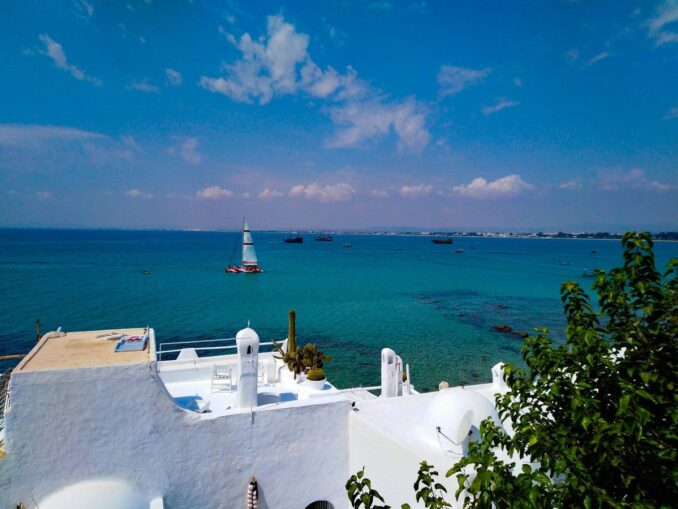
The amount of precipitation is literally negligible. In Djerba in June you can expect rain all month, but never get it!
The wind inherited from May moderates its pressure closer to June 10-15 – before that it blows at times even violently. Refreshing – no doubt about it. But it also instills in the minds of holidaymakers erroneous ideas about temperature.
However, do not be fooled – even in early June, the weather in Tunisia can play a cruel joke on you. And the local sun, with fairly moderate thermometer readings, can literally burn unprotected areas of the skin in ten minutes.
The nights are somewhat colder. Forecasters sometimes predict only +18-19 °C, but in fact it is usually around +20-23 °C.
Near the water in the evenings you can quite feel the coolness, and a light jacket has a chance of being in demand. However, without it you most likely will not fly away on vacation (from Europe, America?).
By the end of June, the weather in Tunisia “loses its shores”, and a frankly hot time sets in. Daytime temperatures can reach +35 degrees Celsiusand even at night sometimes it does not drop below +28-30 °C.
Water temperature
During most of May, swimming in the sea in Tunisia is not very comfortable. Because the water is heated to +16-17 °C at the beginning of the month and to only +20-21 °C at the end.
A fresh breeze ruffling the water surface does not add optimism. And it forces you to limit yourself to staying on the beach or walking along the coast.
Most holidaymakers, however, are not discouraged by such “weather”. Because many hotels have impressive swimming pools.
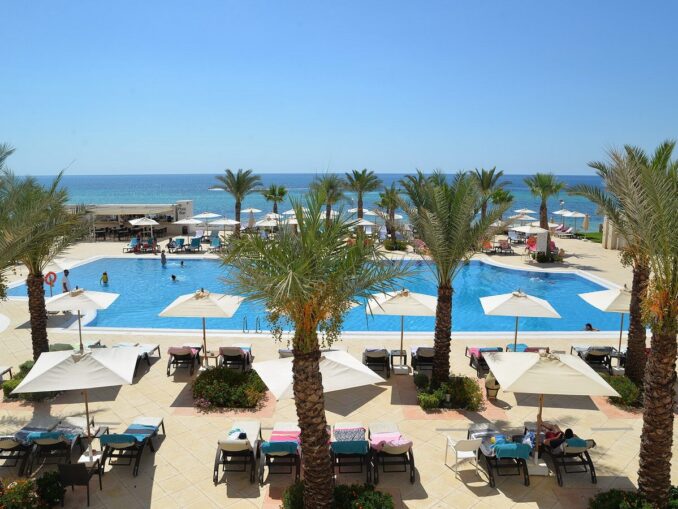
At the beginning of June, the sea in Tunisia warms up literally within a week up to +23-24 °C. And by the end of the month there is every reason to expect +26-27 °C.
And you should carefully look at the company you are swimming with: jellyfish, like tourists, are attracted by warmth.
Here we were thinking about which months are the best to go to Tunisia. So that on the one hand you can relax, and on the other hand, not overheat.
Prices 2026
At the beginning of May, tours to Tunisia from Moscow for 7-8 nights (for example) cost from 140 thousand rubles for two. But if you are counting on everything inclusive, then it is better to focus on the level of 160-170 thousand.
Further – more! That is actually less, of course)
After all, the shift in holiday dates in Tunisia to the second half of May leads to some even cheaper travel packages! And getting the coveted “all inclusive” plus accommodation in a good hotel in Hammamet becomes possible for 150+ thousand rubles (for two people).
But in June – a slightly different story – prices rise to the level of 170-180 thousand rubles. Which is actually quite acceptable – after all, the advantages of staying in Tunisia at the beginning of summer are very obvious.
Here are some good hotels in Hammamet with an 8+ rating.
Where to go
Yasmine Hammamet is the most popular (among Russian tourists) resort area of Tunisia. It can also include Nabeul, a coastal settlement just to the north.
Famous, by the way, for its potters and leather workers.
Hammamet is mainly focused on tranquil family vacationhas a lot of 4-5 star hotels operating on an “all inclusive” system. The main entertainment center is the Carthageland amusement park, which is visually a replica of the ancient medina.
Ticket prices for Carthageland are quite reasonable, and families with children are almost guaranteed to find themselves there. Since otherwise there is no entertainment in Hammamet, consider that there is none.
For adults, we recommend visiting the ancient Medina with mosques and the Kasbah fortress at this modest-sized resort. And the most restless ones are to get to the archaeological excavation of Pupput, made on the site of a vast city of ancient Roman times.
You can walk to Pupput along the coast – given the May weather, this activity shouldn’t break a sweat
Resort
Sousse
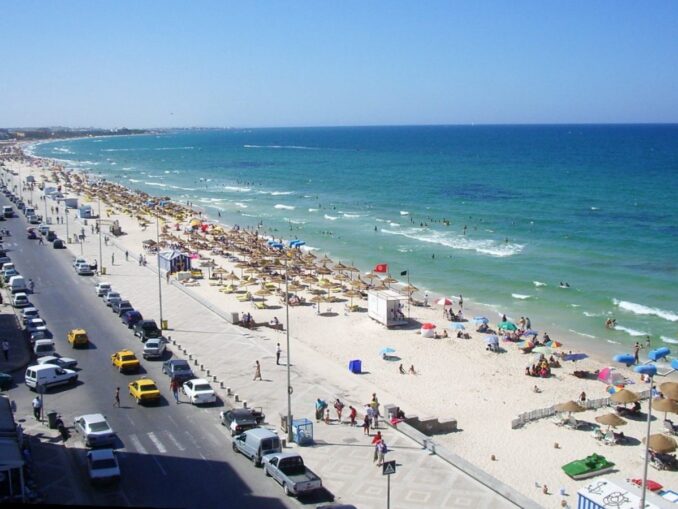
will not suit a quiet audience that does not tolerate excessive noise and constant activity. But young people seem to be very comfortable here.
Lots of entertainment and parties, never-ending nightlife and more than reasonable prices in hotels. Most of them wisely do not decorate themselves with an excessive number of stars, realizing that the bulk of clients have not yet managed to succeed financially.
Sousse has a couple of modest water parks and more substantial attractions. In particular, the old city, Medina, flaunting crooked streets and colorful rugs.
Also worth here visit the beautifully preserved fortresses of Ribat and Kasbah, explore the Great Mosque – all dating back to the 9th century. The local Archaeological Museum is second only to the Bardo in the capital of the country in terms of the size of its collection.
Monastir
shown to tourists who are not rich and do not intend to stay in one place. There is a large airport nearby, and 55 km from the resort are the ruins of El Jem, the “African Colosseum”.
Mahdia, on the contrary, will appeal to tourists with money – those who are not in a hurry and relaxed. However, you can find a good hotel at a reasonable price here too.
On
Djerba Island
Mostly families with children come. Those who do not plan to be particularly active and intend to spend maximum time in a half-asleep state near the sea and swimming pools.
And by the way – jellyfish for some unknown reason, this island is the least loved.
- Here are inexpensive excursions in Tunisia
Things to do
Some iconic sights of Tunisia were mentioned in the previous paragraph. Here – about the rest of course interesting places African country!
For example, about the ruins of Carthage, which are usually reached in transit through the capital of the country, the city of Tunis. And if you’re passing by, it’s a good idea to stop by the National Bardo Museum, an imposing white building with a magnificent collection of ancient artifacts inside.
Unfortunately, this is not why Bardo became world famous. A terrorist attack was committed near and inside the museum in March 2015, during which 20 foreign tourists were killed.
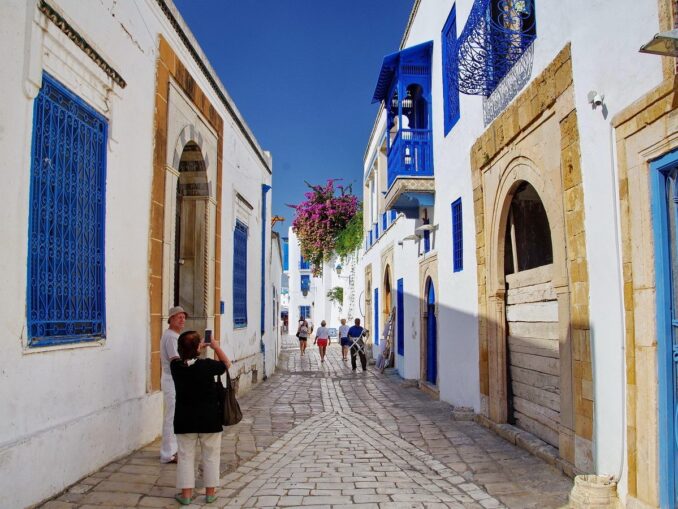
Naturally, it’s worth seeing both in May and June and the medina of Tunisia. And if you think that’s enough – you’ve seen enough of the Arab streets and houses at your favorite resort – then it’s in vain!
For the capital’s old city was not mothballed in the 9th-10th centuries, but developed very dynamically and grew to such an extent that it is easy to get lost in it!
Another obligatory point in the cultural program of a traveler visiting Tunisia is the town of Sidi Bou Said, 20 km northeast of the capital. White walls of houses, blue doors and railings, turquoise Mediterranean Sea – the color of the place is difficult to convey in words.
Note that all of the above can be seen during a long, but one-day excursion
The town of Bulla Regia, not far from Tabarka, is not very well known among the masses. And this is for the better!
Because in the underground villas of the ancient Roman period preserved here, excellent examples of original mosaics have survived.
Fans of the ancient period in the history of the world will also be pleased visit city of Dugga. It may even lead to cultural ecstasy: you can see there the ruins of not only the period of Roman rule, but also the era of Carthage.
Getting there, however, is not easy – from Hammamet to Dougga along the highway is at least 160 km.
The archaeological park in Udna is a smart alternative to Dougga. Moreover, the Roman buildings here are better preserved, and the amphitheater is second in size only to El Jem.
Getting to the park is much easier from Hammamet – only 60 km. Please note – you need to look for Uthina Amphitheater on Google maps!
© Eurotraveler
